LUSID C# SDK
Public Member Functions | Protected Member Functions | Properties | List of all members
Lusid.Sdk.Model.FloatSchedule Class Reference

Schedule for floating rate coupon payments. More...

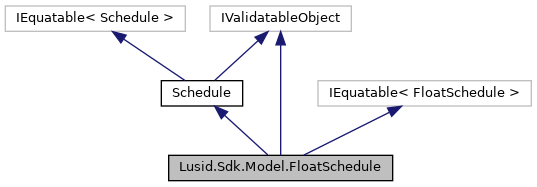
Inheritance diagram for Lusid.Sdk.Model.FloatSchedule:
Inheritance graph
[legend]

Public Member Functions

 FloatSchedule (DateTimeOffset startDate=default(DateTimeOffset), DateTimeOffset maturityDate=default(DateTimeOffset), FlowConventions flowConventions=default(FlowConventions), FlowConventionName conventionName=default(FlowConventionName), int? exDividendDays=default(int?), FlowConventionName indexConventionName=default(FlowConventionName), IndexConvention indexConventions=default(IndexConvention), decimal notional=default(decimal), string paymentCurrency=default(string), decimal spread=default(decimal), string stubType=default(string), ExDividendConfiguration exDividendConfiguration=default(ExDividendConfiguration), Compounding compounding=default(Compounding), string resetConvention=default(string), bool useAnnualisedDirectRates=default(bool), decimal? capRate=default(decimal?), decimal? floorRate=default(decimal?), ScheduleTypeEnum scheduleType=default(ScheduleTypeEnum))
 Initializes a new instance of the FloatSchedule class. More...
 
override string ToString ()
 Returns the string presentation of the object More...
 
override string ToJson ()
 Returns the JSON string presentation of the object More...
 
override bool Equals (object input)
 Returns true if objects are equal More...
 
bool Equals (FloatSchedule input)
 Returns true if FloatSchedule instances are equal More...
 
override int GetHashCode ()
 Gets the hash code More...
 
- Public Member Functions inherited from Lusid.Sdk.Model.Schedule
 Schedule (ScheduleTypeEnum scheduleType=default(ScheduleTypeEnum))
 Initializes a new instance of the Schedule class. More...
 
override string ToString ()
 Returns the string presentation of the object More...
 
override bool Equals (object input)
 Returns true if objects are equal More...
 
bool Equals (Schedule input)
 Returns true if Schedule instances are equal More...
 
override int GetHashCode ()
 Gets the hash code More...
 

Protected Member Functions

 FloatSchedule ()
 Initializes a new instance of the FloatSchedule class. More...
 
IEnumerable< System.ComponentModel.DataAnnotations.ValidationResult > BaseValidate (ValidationContext validationContext)
 To validate all properties of the instance More...
 
- Protected Member Functions inherited from Lusid.Sdk.Model.Schedule
 Schedule ()
 Initializes a new instance of the Schedule class. More...
 
IEnumerable< System.ComponentModel.DataAnnotations.ValidationResult > BaseValidate (ValidationContext validationContext)
 To validate all properties of the instance More...
 

Properties

DateTimeOffset StartDate [get, set]
 Date from which LUSID starts generating the payment schedule. More...
 
DateTimeOffset MaturityDate [get, set]
 Last date of the payment generation schedule. May not necessarily be the maturity date of the underlying instrument (e.g. in case the instrument has multiple payment schedules). More...
 
FlowConventions FlowConventions [get, set]
 Gets or Sets FlowConventions More...
 
FlowConventionName ConventionName [get, set]
 Gets or Sets ConventionName More...
 
int? ExDividendDays [get, set]
 Optional. Number of calendar days in the ex-dividend period. If the settlement date falls in the ex-dividend period then the coupon paid is zero and the accrued interest is negative. If set, this must be a non-negative number. If not set, or set to 0, then there is no ex-dividend period. NOTE: This field is deprecated. If you wish to set the ExDividendDays on a bond, please use the ExDividendConfiguration. More...
 
FlowConventionName IndexConventionName [get, set]
 Gets or Sets IndexConventionName More...
 
IndexConvention IndexConventions [get, set]
 Gets or Sets IndexConventions More...
 
decimal Notional [get, set]
 Scaling factor, the quantity outstanding on which the rate will be paid. More...
 
string PaymentCurrency [get, set]
 Payment currency. This does not have to be the same as the nominal bond or observation/reset currency. More...
 
decimal Spread [get, set]
 Spread over floating rate given as a fraction. More...
 
string StubType [get, set]
 When a payment schedule doesn&#39;t have regular payment intervals just because of the first and/or last coupons of the schedule, we call those irregular coupons stubs. This configuration specifies what type of stub is used when building the schedule Supported values are: None &#x3D; this is a regular payment schedule with no stubs. DO NOT use it with irregular schedules or you will get incorrect and unexpected behaviour. ShortFront &#x3D; this is an irregular payment schedule where only the first coupon is irregular, and covers a payment period that is shorter than the regular payment period. ShortBack &#x3D; this is an irregular payment schedule where only the last coupon is irregular, and covers a payment period that is shorter than the regular payment period. LongFront &#x3D; this is an irregular payment schedule where only the first coupon is irregular, and covers a payment period that is longer than the regular payment period. LongBack &#x3D; this is an irregular payment schedule where only the last coupon is irregular, and covers a payment period that is longer than the regular payment period. Both &#x3D; this is an irregular payment schedule where both the first and the last coupons are irregular, and the length of these periods is calculated based on the first coupon payment date that should have been explicitly set. More...
 
ExDividendConfiguration ExDividendConfiguration [get, set]
 Gets or Sets ExDividendConfiguration More...
 
Compounding Compounding [get, set]
 Gets or Sets Compounding More...
 
string ResetConvention [get, set]
 Control how resets are generated relative to payment convention(s). Default value: InAdvance. Available values: InAdvance, InArrears. More...
 
bool UseAnnualisedDirectRates [get, set]
 Flag indicating whether to use daily updated annualised interest rates for calculating the accrued interest. Defaults to false. More...
 
decimal? CapRate [get, set]
 The maximum floating rate which a cashflow can accrue. More...
 
decimal? FloorRate [get, set]
 The minimum floating rate which a cashflow can accrue. More...
 
- Properties inherited from Lusid.Sdk.Model.Schedule
ScheduleTypeEnum ScheduleType [get, set]
 Available values: FixedSchedule, FloatSchedule, OptionalitySchedule, StepSchedule, Exercise, FxRateSchedule, FxLinkedNotionalSchedule, BondConversionSchedule, Invalid. More...
 

Additional Inherited Members

- Public Types inherited from Lusid.Sdk.Model.Schedule
enum class  ScheduleTypeEnum {
  FixedSchedule = 1 , FloatSchedule = 2 , OptionalitySchedule = 3 , StepSchedule = 4 ,
  Exercise = 5 , FxRateSchedule = 6 , FxLinkedNotionalSchedule = 7 , BondConversionSchedule = 8 ,
  Invalid = 9
}
 Available values: FixedSchedule, FloatSchedule, OptionalitySchedule, StepSchedule, Exercise, FxRateSchedule, FxLinkedNotionalSchedule, BondConversionSchedule, Invalid. More...
 

Detailed Description

Schedule for floating rate coupon payments.

Constructor & Destructor Documentation

◆ FloatSchedule() [1/2]

Lusid.Sdk.Model.FloatSchedule.FloatSchedule ( )
inlineprotected

Initializes a new instance of the FloatSchedule class.

◆ FloatSchedule() [2/2]

Lusid.Sdk.Model.FloatSchedule.FloatSchedule ( DateTimeOffset  startDate = default(DateTimeOffset),
DateTimeOffset  maturityDate = default(DateTimeOffset),
FlowConventions  flowConventions = default(FlowConventions),
FlowConventionName  conventionName = default(FlowConventionName),
int?  exDividendDays = default(int?),
FlowConventionName  indexConventionName = default(FlowConventionName),
IndexConvention  indexConventions = default(IndexConvention),
decimal  notional = default(decimal),
string  paymentCurrency = default(string),
decimal  spread = default(decimal),
string  stubType = default(string),
ExDividendConfiguration  exDividendConfiguration = default(ExDividendConfiguration),
Compounding  compounding = default(Compounding),
string  resetConvention = default(string),
bool  useAnnualisedDirectRates = default(bool),
decimal?  capRate = default(decimal?),
decimal?  floorRate = default(decimal?),
ScheduleTypeEnum  scheduleType = default(ScheduleTypeEnum) 
)
inline

Initializes a new instance of the FloatSchedule class.

Parameters
startDateDate from which LUSID starts generating the payment schedule..
maturityDateLast date of the payment generation schedule. May not necessarily be the maturity date of the underlying instrument (e.g. in case the instrument has multiple payment schedules)..
flowConventionsflowConventions.
conventionNameconventionName.
exDividendDaysOptional. Number of calendar days in the ex-dividend period. If the settlement date falls in the ex-dividend period then the coupon paid is zero and the accrued interest is negative. If set, this must be a non-negative number. If not set, or set to 0, then there is no ex-dividend period. NOTE: This field is deprecated. If you wish to set the ExDividendDays on a bond, please use the ExDividendConfiguration..
indexConventionNameindexConventionName.
indexConventionsindexConventions.
notionalScaling factor, the quantity outstanding on which the rate will be paid..
paymentCurrencyPayment currency. This does not have to be the same as the nominal bond or observation/reset currency. (required).
spreadSpread over floating rate given as a fraction..
stubTypeWhen a payment schedule doesn&#39;t have regular payment intervals just because of the first and/or last coupons of the schedule, we call those irregular coupons stubs. This configuration specifies what type of stub is used when building the schedule Supported values are: None &#x3D; this is a regular payment schedule with no stubs. DO NOT use it with irregular schedules or you will get incorrect and unexpected behaviour. ShortFront &#x3D; this is an irregular payment schedule where only the first coupon is irregular, and covers a payment period that is shorter than the regular payment period. ShortBack &#x3D; this is an irregular payment schedule where only the last coupon is irregular, and covers a payment period that is shorter than the regular payment period. LongFront &#x3D; this is an irregular payment schedule where only the first coupon is irregular, and covers a payment period that is longer than the regular payment period. LongBack &#x3D; this is an irregular payment schedule where only the last coupon is irregular, and covers a payment period that is longer than the regular payment period. Both &#x3D; this is an irregular payment schedule where both the first and the last coupons are irregular, and the length of these periods is calculated based on the first coupon payment date that should have been explicitly set..
exDividendConfigurationexDividendConfiguration.
compoundingcompounding.
resetConventionControl how resets are generated relative to payment convention(s). Default value: InAdvance. Available values: InAdvance, InArrears..
useAnnualisedDirectRatesFlag indicating whether to use daily updated annualised interest rates for calculating the accrued interest. Defaults to false..
capRateThe maximum floating rate which a cashflow can accrue..
floorRateThe minimum floating rate which a cashflow can accrue..
scheduleTypeAvailable values: FixedSchedule, FloatSchedule, OptionalitySchedule, StepSchedule, Exercise, FxRateSchedule, FxLinkedNotionalSchedule, BondConversionSchedule, Invalid. (required) (default to "FloatSchedule").

Member Function Documentation

◆ BaseValidate()

IEnumerable<System.ComponentModel.DataAnnotations.ValidationResult> Lusid.Sdk.Model.FloatSchedule.BaseValidate ( ValidationContext  validationContext)
inlineprotected

To validate all properties of the instance

Parameters
validationContextValidation context
Returns
Validation Result

◆ Equals() [1/2]

bool Lusid.Sdk.Model.FloatSchedule.Equals ( FloatSchedule  input)
inline

Returns true if FloatSchedule instances are equal

Parameters
inputInstance of FloatSchedule to be compared
Returns
Boolean

◆ Equals() [2/2]

override bool Lusid.Sdk.Model.FloatSchedule.Equals ( object  input)
inline

Returns true if objects are equal

Parameters
inputObject to be compared
Returns
Boolean

◆ GetHashCode()

override int Lusid.Sdk.Model.FloatSchedule.GetHashCode ( )
inline

Gets the hash code

Returns
Hash code

◆ ToJson()

override string Lusid.Sdk.Model.FloatSchedule.ToJson ( )
inlinevirtual

Returns the JSON string presentation of the object

Returns
JSON string presentation of the object

Reimplemented from Lusid.Sdk.Model.Schedule.

◆ ToString()

override string Lusid.Sdk.Model.FloatSchedule.ToString ( )
inline

Returns the string presentation of the object

Returns
String presentation of the object

Property Documentation

◆ CapRate

decimal? Lusid.Sdk.Model.FloatSchedule.CapRate
getset

The maximum floating rate which a cashflow can accrue.

The maximum floating rate which a cashflow can accrue.

◆ Compounding

Compounding Lusid.Sdk.Model.FloatSchedule.Compounding
getset

Gets or Sets Compounding

◆ ConventionName

FlowConventionName Lusid.Sdk.Model.FloatSchedule.ConventionName
getset

Gets or Sets ConventionName

◆ ExDividendConfiguration

ExDividendConfiguration Lusid.Sdk.Model.FloatSchedule.ExDividendConfiguration
getset

◆ ExDividendDays

int? Lusid.Sdk.Model.FloatSchedule.ExDividendDays
getset

Optional. Number of calendar days in the ex-dividend period. If the settlement date falls in the ex-dividend period then the coupon paid is zero and the accrued interest is negative. If set, this must be a non-negative number. If not set, or set to 0, then there is no ex-dividend period. NOTE: This field is deprecated. If you wish to set the ExDividendDays on a bond, please use the ExDividendConfiguration.

Optional. Number of calendar days in the ex-dividend period. If the settlement date falls in the ex-dividend period then the coupon paid is zero and the accrued interest is negative. If set, this must be a non-negative number. If not set, or set to 0, then there is no ex-dividend period. NOTE: This field is deprecated. If you wish to set the ExDividendDays on a bond, please use the ExDividendConfiguration.

◆ FloorRate

decimal? Lusid.Sdk.Model.FloatSchedule.FloorRate
getset

The minimum floating rate which a cashflow can accrue.

The minimum floating rate which a cashflow can accrue.

◆ FlowConventions

FlowConventions Lusid.Sdk.Model.FloatSchedule.FlowConventions
getset

Gets or Sets FlowConventions

◆ IndexConventionName

FlowConventionName Lusid.Sdk.Model.FloatSchedule.IndexConventionName
getset

Gets or Sets IndexConventionName

◆ IndexConventions

IndexConvention Lusid.Sdk.Model.FloatSchedule.IndexConventions
getset

Gets or Sets IndexConventions

◆ MaturityDate

DateTimeOffset Lusid.Sdk.Model.FloatSchedule.MaturityDate
getset

Last date of the payment generation schedule. May not necessarily be the maturity date of the underlying instrument (e.g. in case the instrument has multiple payment schedules).

Last date of the payment generation schedule. May not necessarily be the maturity date of the underlying instrument (e.g. in case the instrument has multiple payment schedules).

◆ Notional

decimal Lusid.Sdk.Model.FloatSchedule.Notional
getset

Scaling factor, the quantity outstanding on which the rate will be paid.

Scaling factor, the quantity outstanding on which the rate will be paid.

◆ PaymentCurrency

string Lusid.Sdk.Model.FloatSchedule.PaymentCurrency
getset

Payment currency. This does not have to be the same as the nominal bond or observation/reset currency.

Payment currency. This does not have to be the same as the nominal bond or observation/reset currency.

◆ ResetConvention

string Lusid.Sdk.Model.FloatSchedule.ResetConvention
getset

Control how resets are generated relative to payment convention(s). Default value: InAdvance. Available values: InAdvance, InArrears.

Control how resets are generated relative to payment convention(s). Default value: InAdvance. Available values: InAdvance, InArrears.

◆ Spread

decimal Lusid.Sdk.Model.FloatSchedule.Spread
getset

Spread over floating rate given as a fraction.

Spread over floating rate given as a fraction.

◆ StartDate

DateTimeOffset Lusid.Sdk.Model.FloatSchedule.StartDate
getset

Date from which LUSID starts generating the payment schedule.

Date from which LUSID starts generating the payment schedule.

◆ StubType

string Lusid.Sdk.Model.FloatSchedule.StubType
getset

When a payment schedule doesn&#39;t have regular payment intervals just because of the first and/or last coupons of the schedule, we call those irregular coupons stubs. This configuration specifies what type of stub is used when building the schedule Supported values are: None &#x3D; this is a regular payment schedule with no stubs. DO NOT use it with irregular schedules or you will get incorrect and unexpected behaviour. ShortFront &#x3D; this is an irregular payment schedule where only the first coupon is irregular, and covers a payment period that is shorter than the regular payment period. ShortBack &#x3D; this is an irregular payment schedule where only the last coupon is irregular, and covers a payment period that is shorter than the regular payment period. LongFront &#x3D; this is an irregular payment schedule where only the first coupon is irregular, and covers a payment period that is longer than the regular payment period. LongBack &#x3D; this is an irregular payment schedule where only the last coupon is irregular, and covers a payment period that is longer than the regular payment period. Both &#x3D; this is an irregular payment schedule where both the first and the last coupons are irregular, and the length of these periods is calculated based on the first coupon payment date that should have been explicitly set.
When a payment schedule doesn&#39;t have regular payment intervals just because of the first and/or last coupons of the schedule, we call those irregular coupons stubs. This configuration specifies what type of stub is used when building the schedule Supported values are: None &#x3D; this is a regular payment schedule with no stubs. DO NOT use it with irregular schedules or you will get incorrect and unexpected behaviour. ShortFront &#x3D; this is an irregular payment schedule where only the first coupon is irregular, and covers a payment period that is shorter than the regular payment period. ShortBack &#x3D; this is an irregular payment schedule where only the last coupon is irregular, and covers a payment period that is shorter than the regular payment period. LongFront &#x3D; this is an irregular payment schedule where only the first coupon is irregular, and covers a payment period that is longer than the regular payment period. LongBack &#x3D; this is an irregular payment schedule where only the last coupon is irregular, and covers a payment period that is longer than the regular payment period. Both &#x3D; this is an irregular payment schedule where both the first and the last coupons are irregular, and the length of these periods is calculated based on the first coupon payment date that should have been explicitly set.

◆ UseAnnualisedDirectRates

bool Lusid.Sdk.Model.FloatSchedule.UseAnnualisedDirectRates
getset

Flag indicating whether to use daily updated annualised interest rates for calculating the accrued interest. Defaults to false.

Flag indicating whether to use daily updated annualised interest rates for calculating the accrued interest. Defaults to false.


The documentation for this class was generated from the following file: