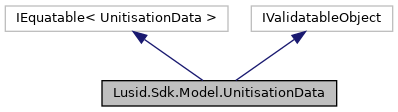
UnitisationData
More...
|
| decimal | SharesInIssue [get, set] |
| | The number of shares in issue at a valuation point. More...
|
| |
| decimal | UnitPrice [get, set] |
| | The price of one unit of the share class at a valuation point. More...
|
| |
| decimal | NetDealingUnits [get, set] |
| | The net dealing in units for the share class at a valuation point. This could be the sum of negative redemptions (in units) and positive subscriptions (in units). More...
|
| |
◆ UnitisationData() [1/2]
| Lusid.Sdk.Model.UnitisationData.UnitisationData |
( |
| ) |
|
|
inlineprotected |
◆ UnitisationData() [2/2]
| Lusid.Sdk.Model.UnitisationData.UnitisationData |
( |
decimal |
sharesInIssue = default(decimal), |
|
|
decimal |
unitPrice = default(decimal), |
|
|
decimal |
netDealingUnits = default(decimal) |
|
) |
| |
|
inline |
Initializes a new instance of the UnitisationData class.
- Parameters
-
| sharesInIssue | The number of shares in issue at a valuation point. (required). |
| unitPrice | The price of one unit of the share class at a valuation point. (required). |
| netDealingUnits | The net dealing in units for the share class at a valuation point. This could be the sum of negative redemptions (in units) and positive subscriptions (in units). (required). |
◆ Equals() [1/2]
| override bool Lusid.Sdk.Model.UnitisationData.Equals |
( |
object |
input | ) |
|
|
inline |
Returns true if objects are equal
- Parameters
-
| input | Object to be compared |
- Returns
- Boolean
◆ Equals() [2/2]
Returns true if UnitisationData instances are equal
- Parameters
-
- Returns
- Boolean
◆ GetHashCode()
| override int Lusid.Sdk.Model.UnitisationData.GetHashCode |
( |
| ) |
|
|
inline |
Gets the hash code
- Returns
- Hash code
◆ ToJson()
| virtual string Lusid.Sdk.Model.UnitisationData.ToJson |
( |
| ) |
|
|
inlinevirtual |
Returns the JSON string presentation of the object
- Returns
- JSON string presentation of the object
◆ ToString()
| override string Lusid.Sdk.Model.UnitisationData.ToString |
( |
| ) |
|
|
inline |
Returns the string presentation of the object
- Returns
- String presentation of the object
◆ NetDealingUnits
| decimal Lusid.Sdk.Model.UnitisationData.NetDealingUnits |
|
getset |
The net dealing in units for the share class at a valuation point. This could be the sum of negative redemptions (in units) and positive subscriptions (in units).
The net dealing in units for the share class at a valuation point. This could be the sum of negative redemptions (in units) and positive subscriptions (in units).
◆ SharesInIssue
| decimal Lusid.Sdk.Model.UnitisationData.SharesInIssue |
|
getset |
The number of shares in issue at a valuation point.
The number of shares in issue at a valuation point.
◆ UnitPrice
| decimal Lusid.Sdk.Model.UnitisationData.UnitPrice |
|
getset |
The price of one unit of the share class at a valuation point.
The price of one unit of the share class at a valuation point.
The documentation for this class was generated from the following file:
- /home/docs/checkouts/readthedocs.org/user_builds/lusid-sdk-csharp/checkouts/latest/sdk/Lusid.Sdk/Model/UnitisationData.cs