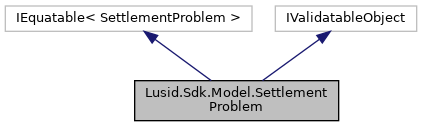
SettlementProblem
More...
|
| string | SettlementInstructionId [get, set] |
| | The id of the problematic settlement instruction. Combined with the portfolio id this uniquely identifies a settlement instruction More...
|
| |
| string | Category [get, set] |
| | The category this instruction belongs to More...
|
| |
| string | Status [get, set] |
| | The status of the settlement instruction. Available values: Invalid, Rejected, Applied, Orphan. More...
|
| |
◆ SettlementProblem() [1/2]
| Lusid.Sdk.Model.SettlementProblem.SettlementProblem |
( |
| ) |
|
|
inlineprotected |
◆ SettlementProblem() [2/2]
| Lusid.Sdk.Model.SettlementProblem.SettlementProblem |
( |
string |
settlementInstructionId = default(string), |
|
|
string |
category = default(string), |
|
|
string |
status = default(string) |
|
) |
| |
|
inline |
Initializes a new instance of the SettlementProblem class.
- Parameters
-
| settlementInstructionId | The id of the problematic settlement instruction. Combined with the portfolio id this uniquely identifies a settlement instruction (required). |
| category | The category this instruction belongs to (required). |
| status | The status of the settlement instruction. Available values: Invalid, Rejected, Applied, Orphan. (required). |
◆ Equals() [1/2]
| override bool Lusid.Sdk.Model.SettlementProblem.Equals |
( |
object |
input | ) |
|
|
inline |
Returns true if objects are equal
- Parameters
-
| input | Object to be compared |
- Returns
- Boolean
◆ Equals() [2/2]
◆ GetHashCode()
| override int Lusid.Sdk.Model.SettlementProblem.GetHashCode |
( |
| ) |
|
|
inline |
Gets the hash code
- Returns
- Hash code
◆ ToJson()
| virtual string Lusid.Sdk.Model.SettlementProblem.ToJson |
( |
| ) |
|
|
inlinevirtual |
Returns the JSON string presentation of the object
- Returns
- JSON string presentation of the object
◆ ToString()
| override string Lusid.Sdk.Model.SettlementProblem.ToString |
( |
| ) |
|
|
inline |
Returns the string presentation of the object
- Returns
- String presentation of the object
◆ Category
| string Lusid.Sdk.Model.SettlementProblem.Category |
|
getset |
The category this instruction belongs to
The category this instruction belongs to
◆ SettlementInstructionId
| string Lusid.Sdk.Model.SettlementProblem.SettlementInstructionId |
|
getset |
The id of the problematic settlement instruction. Combined with the portfolio id this uniquely identifies a settlement instruction
The id of the problematic settlement instruction. Combined with the portfolio id this uniquely identifies a settlement instruction
◆ Status
| string Lusid.Sdk.Model.SettlementProblem.Status |
|
getset |
The status of the settlement instruction. Available values: Invalid, Rejected, Applied, Orphan.
The status of the settlement instruction. Available values: Invalid, Rejected, Applied, Orphan.
The documentation for this class was generated from the following file:
- /home/docs/checkouts/readthedocs.org/user_builds/lusid-sdk-csharp/checkouts/latest/sdk/Lusid.Sdk/Model/SettlementProblem.cs