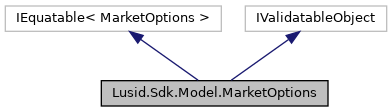
The set of options that control miscellaneous and default market resolution behaviour. A default scope entered here will cause duplicate ("default") rules to be created across all asset types, pointing at that scope. These are aimed at a 'crude' level of control for those who do not wish to fine tune the way that data is resolved. For clients who wish to simply match instruments to prices this is quite possibly sufficient. For those wishing to control market data sources according to requirements based on accuracy or timeliness it is not recommended. In more advanced cases the options should largely be ignored and rules specified per source. If no default scope is supplied, no default rules are created. Where a default scope is supplied, a default rule is constructed per asset type, pointing at that scope, and appended after all specified rules so it is only tried as a last resort. Each default rule is wild-carded within its asset type (for example Quote.{instrumentCodeType}.* or Fx.*.*) rather than being a single fully wild-carded rule, and one (two for Rates) is generated per asset type. Consequently, where no specified rule matches a dependency, the failure reported is this constructed default rule in the provided default scope. It is not recommended to rely on this behaviour, as these rules match a wide range of data and are likely to be slow to resolve. It is better to specify rules for the data you require in the MarketRules of the MarketContext.
More...
|
| | MarketOptions (string defaultSupplier=default(string), string defaultInstrumentCodeType=default(string), string defaultScope=default(string), bool attemptToInferMissingFx=default(bool), string calendarScope=default(string), string conventionScope=default(string)) |
| | Initializes a new instance of the MarketOptions class. More...
|
| |
| override string | ToString () |
| | Returns the string presentation of the object More...
|
| |
| virtual string | ToJson () |
| | Returns the JSON string presentation of the object More...
|
| |
| override bool | Equals (object input) |
| | Returns true if objects are equal More...
|
| |
| bool | Equals (MarketOptions input) |
| | Returns true if MarketOptions instances are equal More...
|
| |
| override int | GetHashCode () |
| | Gets the hash code More...
|
| |
|
| string | DefaultSupplier [get, set] |
| | The default supplier of data. This controls which 'dialect' is used to find particular market data. e.g. one supplier might address data by RIC, another by PermId More...
|
| |
| string | DefaultInstrumentCodeType [get, set] |
| | When instrument quotes are searched for, what identifier should be used by default More...
|
| |
| string | DefaultScope [get, set] |
| | The scope in which to search for data when applying default rules. This is optional: if omitted, no default rules are created and market data is resolved only via the explicitly specified market data key rules. More...
|
| |
| bool | AttemptToInferMissingFx [get, set] |
| | if true will calculate a missing Fx pair (e.g. THBJPY) from the inverse JPYTHB or from standardised pairs against USD, e.g. THBUSD and JPYUSD More...
|
| |
| string | CalendarScope [get, set] |
| | The scope in which holiday calendars stored More...
|
| |
| string | ConventionScope [get, set] |
| | The scope in which conventions stored More...
|
| |
The set of options that control miscellaneous and default market resolution behaviour. A default scope entered here will cause duplicate ("default") rules to be created across all asset types, pointing at that scope. These are aimed at a 'crude' level of control for those who do not wish to fine tune the way that data is resolved. For clients who wish to simply match instruments to prices this is quite possibly sufficient. For those wishing to control market data sources according to requirements based on accuracy or timeliness it is not recommended. In more advanced cases the options should largely be ignored and rules specified per source. If no default scope is supplied, no default rules are created. Where a default scope is supplied, a default rule is constructed per asset type, pointing at that scope, and appended after all specified rules so it is only tried as a last resort. Each default rule is wild-carded within its asset type (for example Quote.{instrumentCodeType}.* or Fx.*.*) rather than being a single fully wild-carded rule, and one (two for Rates) is generated per asset type. Consequently, where no specified rule matches a dependency, the failure reported is this constructed default rule in the provided default scope. It is not recommended to rely on this behaviour, as these rules match a wide range of data and are likely to be slow to resolve. It is better to specify rules for the data you require in the MarketRules of the MarketContext.
◆ MarketOptions()
| Lusid.Sdk.Model.MarketOptions.MarketOptions |
( |
string |
defaultSupplier = default(string), |
|
|
string |
defaultInstrumentCodeType = default(string), |
|
|
string |
defaultScope = default(string), |
|
|
bool |
attemptToInferMissingFx = default(bool), |
|
|
string |
calendarScope = default(string), |
|
|
string |
conventionScope = default(string) |
|
) |
| |
|
inline |
Initializes a new instance of the MarketOptions class.
- Parameters
-
| defaultSupplier | The default supplier of data. This controls which 'dialect' is used to find particular market data. e.g. one supplier might address data by RIC, another by PermId. |
| defaultInstrumentCodeType | When instrument quotes are searched for, what identifier should be used by default. |
| defaultScope | The scope in which to search for data when applying default rules. This is optional: if omitted, no default rules are created and market data is resolved only via the explicitly specified market data key rules.. |
| attemptToInferMissingFx | if true will calculate a missing Fx pair (e.g. THBJPY) from the inverse JPYTHB or from standardised pairs against USD, e.g. THBUSD and JPYUSD. |
| calendarScope | The scope in which holiday calendars stored. |
| conventionScope | The scope in which conventions stored. |
◆ Equals() [1/2]
Returns true if MarketOptions instances are equal
- Parameters
-
- Returns
- Boolean
◆ Equals() [2/2]
| override bool Lusid.Sdk.Model.MarketOptions.Equals |
( |
object |
input | ) |
|
|
inline |
Returns true if objects are equal
- Parameters
-
| input | Object to be compared |
- Returns
- Boolean
◆ GetHashCode()
| override int Lusid.Sdk.Model.MarketOptions.GetHashCode |
( |
| ) |
|
|
inline |
Gets the hash code
- Returns
- Hash code
◆ ToJson()
| virtual string Lusid.Sdk.Model.MarketOptions.ToJson |
( |
| ) |
|
|
inlinevirtual |
Returns the JSON string presentation of the object
- Returns
- JSON string presentation of the object
◆ ToString()
| override string Lusid.Sdk.Model.MarketOptions.ToString |
( |
| ) |
|
|
inline |
Returns the string presentation of the object
- Returns
- String presentation of the object
◆ AttemptToInferMissingFx
| bool Lusid.Sdk.Model.MarketOptions.AttemptToInferMissingFx |
|
getset |
if true will calculate a missing Fx pair (e.g. THBJPY) from the inverse JPYTHB or from standardised pairs against USD, e.g. THBUSD and JPYUSD
if true will calculate a missing Fx pair (e.g. THBJPY) from the inverse JPYTHB or from standardised pairs against USD, e.g. THBUSD and JPYUSD
◆ CalendarScope
| string Lusid.Sdk.Model.MarketOptions.CalendarScope |
|
getset |
The scope in which holiday calendars stored
The scope in which holiday calendars stored
◆ ConventionScope
| string Lusid.Sdk.Model.MarketOptions.ConventionScope |
|
getset |
The scope in which conventions stored
The scope in which conventions stored
◆ DefaultInstrumentCodeType
| string Lusid.Sdk.Model.MarketOptions.DefaultInstrumentCodeType |
|
getset |
When instrument quotes are searched for, what identifier should be used by default
When instrument quotes are searched for, what identifier should be used by default
◆ DefaultScope
| string Lusid.Sdk.Model.MarketOptions.DefaultScope |
|
getset |
The scope in which to search for data when applying default rules. This is optional: if omitted, no default rules are created and market data is resolved only via the explicitly specified market data key rules.
The scope in which to search for data when applying default rules. This is optional: if omitted, no default rules are created and market data is resolved only via the explicitly specified market data key rules.
◆ DefaultSupplier
| string Lusid.Sdk.Model.MarketOptions.DefaultSupplier |
|
getset |
The default supplier of data. This controls which 'dialect' is used to find particular market data. e.g. one supplier might address data by RIC, another by PermId
The default supplier of data. This controls which 'dialect' is used to find particular market data. e.g. one supplier might address data by RIC, another by PermId
The documentation for this class was generated from the following file:
- /home/docs/checkouts/readthedocs.org/user_builds/lusid-sdk-csharp/checkouts/latest/sdk/Lusid.Sdk/Model/MarketOptions.cs