LUSID C# SDK
Public Member Functions | Protected Member Functions | Properties | List of all members
Lusid.Sdk.Model.FundValuationRequest Class Reference

Specification object for the parameters of a valuation More...

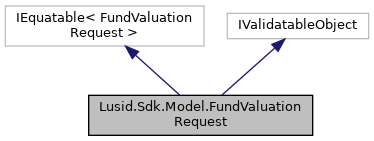
Inheritance diagram for Lusid.Sdk.Model.FundValuationRequest:
Inheritance graph
[legend]

Public Member Functions

 FundValuationRequest (DateTimeOffset? asAt=default(DateTimeOffset?), List< AggregateSpec > metrics=default(List< AggregateSpec >), List< string > groupBy=default(List< string >), List< PropertyFilter > filters=default(List< PropertyFilter >), List< OrderBySpec > sort=default(List< OrderBySpec >), bool equipWithSubtotals=default(bool), bool returnResultAsExpandedTypes=default(bool), OrderFlowConfiguration includeOrderFlow=default(OrderFlowConfiguration), FundValuationSchedule fundValuationSchedule=default(FundValuationSchedule), MarketDataOverrides marketDataOverrides=default(MarketDataOverrides), ResourceId corporateActionSourceId=default(ResourceId))
 Initializes a new instance of the FundValuationRequest class. More...
 
override string ToString ()
 Returns the string presentation of the object More...
 
virtual string ToJson ()
 Returns the JSON string presentation of the object More...
 
override bool Equals (object input)
 Returns true if objects are equal More...
 
bool Equals (FundValuationRequest input)
 Returns true if FundValuationRequest instances are equal More...
 
override int GetHashCode ()
 Gets the hash code More...
 

Protected Member Functions

 FundValuationRequest ()
 Initializes a new instance of the FundValuationRequest class. More...
 

Properties

DateTimeOffset? AsAt [get, set]
 The asAt date to use. More...
 
List< AggregateSpecMetrics [get, set]
 The set of specifications to calculate or retrieve during the valuation and present in the results. For example: AggregateSpec(&#39;Valuation/PV&#39;,&#39;Sum&#39;) for returning the PV (present value) of holdings AggregateSpec(&#39;Holding/default/Units&#39;,&#39;Sum&#39;) for returning the units of holidays AggregateSpec(&#39;Instrument/default/LusidInstrumentId&#39;,&#39;Value&#39;) for returning the Lusid Instrument identifier More...
 
List< string > GroupBy [get, set]
 The set of items by which to perform grouping. This primarily matters when one or more of the metric operators is a mapping that reduces set size, e.g. sum or proportion. The group-by statement determines the set of keys by which to break the results out. More...
 
List< PropertyFilterFilters [get, set]
 A set of filters to use to reduce the data found in a request. Equivalent to the &#39;where ...&#39; part of a Sql select statement. For example, filter a set of values within a given range or matching a particular value. More...
 
List< OrderBySpecSort [get, set]
 A (possibly empty/null) set of specifications for how to order the results. More...
 
bool EquipWithSubtotals [get, set]
 Flag directing the Valuation call to populate the results with subtotals of aggregates. More...
 
bool ReturnResultAsExpandedTypes [get, set]
 Financially meaningful results can be presented as either simple flat types or more complex expanded types. For example, the present value (PV) of a holding could be represented either as a simple decimal (with currency implied) or as a decimal-currency pair. This flag allows either representation to be returned. In the PV example, the returned value would be the decimal-currency pair if this flag is true, or the decimal only if this flag is false. More...
 
OrderFlowConfiguration IncludeOrderFlow [get, set]
 Gets or Sets IncludeOrderFlow More...
 
FundValuationSchedule FundValuationSchedule [get, set]
 Gets or Sets FundValuationSchedule More...
 
MarketDataOverrides MarketDataOverrides [get, set]
 Gets or Sets MarketDataOverrides More...
 
ResourceId CorporateActionSourceId [get, set]
 Gets or Sets CorporateActionSourceId More...
 

Detailed Description

Specification object for the parameters of a valuation

Constructor & Destructor Documentation

◆ FundValuationRequest() [1/2]

Lusid.Sdk.Model.FundValuationRequest.FundValuationRequest ( )
inlineprotected

Initializes a new instance of the FundValuationRequest class.

◆ FundValuationRequest() [2/2]

Lusid.Sdk.Model.FundValuationRequest.FundValuationRequest ( DateTimeOffset?  asAt = default(DateTimeOffset?),
List< AggregateSpec metrics = default(List<AggregateSpec>),
List< string >  groupBy = default(List<string>),
List< PropertyFilter filters = default(List<PropertyFilter>),
List< OrderBySpec sort = default(List<OrderBySpec>),
bool  equipWithSubtotals = default(bool),
bool  returnResultAsExpandedTypes = default(bool),
OrderFlowConfiguration  includeOrderFlow = default(OrderFlowConfiguration),
FundValuationSchedule  fundValuationSchedule = default(FundValuationSchedule),
MarketDataOverrides  marketDataOverrides = default(MarketDataOverrides),
ResourceId  corporateActionSourceId = default(ResourceId) 
)
inline

Initializes a new instance of the FundValuationRequest class.

Parameters
asAtThe asAt date to use..
metricsThe set of specifications to calculate or retrieve during the valuation and present in the results. For example: AggregateSpec(&#39;Valuation/PV&#39;,&#39;Sum&#39;) for returning the PV (present value) of holdings AggregateSpec(&#39;Holding/default/Units&#39;,&#39;Sum&#39;) for returning the units of holidays AggregateSpec(&#39;Instrument/default/LusidInstrumentId&#39;,&#39;Value&#39;) for returning the Lusid Instrument identifier (required).
groupByThe set of items by which to perform grouping. This primarily matters when one or more of the metric operators is a mapping that reduces set size, e.g. sum or proportion. The group-by statement determines the set of keys by which to break the results out..
filtersA set of filters to use to reduce the data found in a request. Equivalent to the &#39;where ...&#39; part of a Sql select statement. For example, filter a set of values within a given range or matching a particular value..
sortA (possibly empty/null) set of specifications for how to order the results..
equipWithSubtotalsFlag directing the Valuation call to populate the results with subtotals of aggregates..
returnResultAsExpandedTypesFinancially meaningful results can be presented as either simple flat types or more complex expanded types. For example, the present value (PV) of a holding could be represented either as a simple decimal (with currency implied) or as a decimal-currency pair. This flag allows either representation to be returned. In the PV example, the returned value would be the decimal-currency pair if this flag is true, or the decimal only if this flag is false..
includeOrderFlowincludeOrderFlow.
fundValuationSchedulefundValuationSchedule (required).
marketDataOverridesmarketDataOverrides.
corporateActionSourceIdcorporateActionSourceId.

Member Function Documentation

◆ Equals() [1/2]

bool Lusid.Sdk.Model.FundValuationRequest.Equals ( FundValuationRequest  input)
inline

Returns true if FundValuationRequest instances are equal

Parameters
inputInstance of FundValuationRequest to be compared
Returns
Boolean

◆ Equals() [2/2]

override bool Lusid.Sdk.Model.FundValuationRequest.Equals ( object  input)
inline

Returns true if objects are equal

Parameters
inputObject to be compared
Returns
Boolean

◆ GetHashCode()

override int Lusid.Sdk.Model.FundValuationRequest.GetHashCode ( )
inline

Gets the hash code

Returns
Hash code

◆ ToJson()

virtual string Lusid.Sdk.Model.FundValuationRequest.ToJson ( )
inlinevirtual

Returns the JSON string presentation of the object

Returns
JSON string presentation of the object

◆ ToString()

override string Lusid.Sdk.Model.FundValuationRequest.ToString ( )
inline

Returns the string presentation of the object

Returns
String presentation of the object

Property Documentation

◆ AsAt

DateTimeOffset? Lusid.Sdk.Model.FundValuationRequest.AsAt
getset

The asAt date to use.

The asAt date to use.

◆ CorporateActionSourceId

ResourceId Lusid.Sdk.Model.FundValuationRequest.CorporateActionSourceId
getset

Gets or Sets CorporateActionSourceId

◆ EquipWithSubtotals

bool Lusid.Sdk.Model.FundValuationRequest.EquipWithSubtotals
getset

Flag directing the Valuation call to populate the results with subtotals of aggregates.

Flag directing the Valuation call to populate the results with subtotals of aggregates.

◆ Filters

List<PropertyFilter> Lusid.Sdk.Model.FundValuationRequest.Filters
getset

A set of filters to use to reduce the data found in a request. Equivalent to the &#39;where ...&#39; part of a Sql select statement. For example, filter a set of values within a given range or matching a particular value.

A set of filters to use to reduce the data found in a request. Equivalent to the &#39;where ...&#39; part of a Sql select statement. For example, filter a set of values within a given range or matching a particular value.

◆ FundValuationSchedule

FundValuationSchedule Lusid.Sdk.Model.FundValuationRequest.FundValuationSchedule
getset

Gets or Sets FundValuationSchedule

◆ GroupBy

List<string> Lusid.Sdk.Model.FundValuationRequest.GroupBy
getset

The set of items by which to perform grouping. This primarily matters when one or more of the metric operators is a mapping that reduces set size, e.g. sum or proportion. The group-by statement determines the set of keys by which to break the results out.

The set of items by which to perform grouping. This primarily matters when one or more of the metric operators is a mapping that reduces set size, e.g. sum or proportion. The group-by statement determines the set of keys by which to break the results out.

◆ IncludeOrderFlow

OrderFlowConfiguration Lusid.Sdk.Model.FundValuationRequest.IncludeOrderFlow
getset

Gets or Sets IncludeOrderFlow

◆ MarketDataOverrides

MarketDataOverrides Lusid.Sdk.Model.FundValuationRequest.MarketDataOverrides
getset

Gets or Sets MarketDataOverrides

◆ Metrics

List<AggregateSpec> Lusid.Sdk.Model.FundValuationRequest.Metrics
getset

The set of specifications to calculate or retrieve during the valuation and present in the results. For example: AggregateSpec(&#39;Valuation/PV&#39;,&#39;Sum&#39;) for returning the PV (present value) of holdings AggregateSpec(&#39;Holding/default/Units&#39;,&#39;Sum&#39;) for returning the units of holidays AggregateSpec(&#39;Instrument/default/LusidInstrumentId&#39;,&#39;Value&#39;) for returning the Lusid Instrument identifier

The set of specifications to calculate or retrieve during the valuation and present in the results. For example: AggregateSpec(&#39;Valuation/PV&#39;,&#39;Sum&#39;) for returning the PV (present value) of holdings AggregateSpec(&#39;Holding/default/Units&#39;,&#39;Sum&#39;) for returning the units of holidays AggregateSpec(&#39;Instrument/default/LusidInstrumentId&#39;,&#39;Value&#39;) for returning the Lusid Instrument identifier

◆ ReturnResultAsExpandedTypes

bool Lusid.Sdk.Model.FundValuationRequest.ReturnResultAsExpandedTypes
getset

Financially meaningful results can be presented as either simple flat types or more complex expanded types. For example, the present value (PV) of a holding could be represented either as a simple decimal (with currency implied) or as a decimal-currency pair. This flag allows either representation to be returned. In the PV example, the returned value would be the decimal-currency pair if this flag is true, or the decimal only if this flag is false.

Financially meaningful results can be presented as either simple flat types or more complex expanded types. For example, the present value (PV) of a holding could be represented either as a simple decimal (with currency implied) or as a decimal-currency pair. This flag allows either representation to be returned. In the PV example, the returned value would be the decimal-currency pair if this flag is true, or the decimal only if this flag is false.

◆ Sort

List<OrderBySpec> Lusid.Sdk.Model.FundValuationRequest.Sort
getset

A (possibly empty/null) set of specifications for how to order the results.

A (possibly empty/null) set of specifications for how to order the results.


The documentation for this class was generated from the following file: