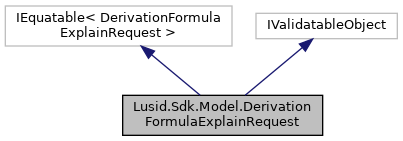
DerivationFormulaExplainRequest
More...
|
| string | EntityType [get, set] |
| | The type of the entity for which the derived property or partial formula is to be resolved against. More...
|
| |
| string | Scope [get, set] |
| | (Optional) The scope that entity exists in. If no scope is provided, the default scope for the entity type will be used. More...
|
| |
| string | Code [get, set] |
| | (Optional) The code of the entity, to be provided for entities that support scope/code retrieval. If no code or identifier is provided, the logical evaluation tree without resolved values is returned. More...
|
| |
| string | SubentityId [get, set] |
| | (Optional) The id of the sub-entity to explain the derived property for. This must be provided along with the scope/code of the parent entity. More...
|
| |
| Dictionary< string, string > | Identifier [get, set] |
| | (Optional). An identifier key/value pair that uniquely identifies the entity to explain the derived property for. This can be either an instrument identifier, or an identifier property. If no code or identifier is provided, the logical evaluation tree without resolved values is returned. More...
|
| |
| string | PropertyKey [get, set] |
| | (Optional) The key of the derived property to get an explanation for. This takes the format {domain}/{scope}/{code}. One of either property key or partial formula must be provided. More...
|
| |
| string | PartialFormula [get, set] |
| | (Optional) A partial derivation formula to get an explanation for. Can be provided in lieu of a property key. One of either property key or partial formula must be provided. More...
|
| |
◆ DerivationFormulaExplainRequest() [1/2]
| Lusid.Sdk.Model.DerivationFormulaExplainRequest.DerivationFormulaExplainRequest |
( |
| ) |
|
|
inlineprotected |
◆ DerivationFormulaExplainRequest() [2/2]
| Lusid.Sdk.Model.DerivationFormulaExplainRequest.DerivationFormulaExplainRequest |
( |
string |
entityType = default(string), |
|
|
string |
scope = default(string), |
|
|
string |
code = default(string), |
|
|
string |
subentityId = default(string), |
|
|
Dictionary< string, string > |
identifier = default(Dictionary<string, string>), |
|
|
string |
propertyKey = default(string), |
|
|
string |
partialFormula = default(string) |
|
) |
| |
|
inline |
Initializes a new instance of the DerivationFormulaExplainRequest class.
- Parameters
-
| entityType | The type of the entity for which the derived property or partial formula is to be resolved against. (required). |
| scope | (Optional) The scope that entity exists in. If no scope is provided, the default scope for the entity type will be used.. |
| code | (Optional) The code of the entity, to be provided for entities that support scope/code retrieval. If no code or identifier is provided, the logical evaluation tree without resolved values is returned.. |
| subentityId | (Optional) The id of the sub-entity to explain the derived property for. This must be provided along with the scope/code of the parent entity.. |
| identifier | (Optional). An identifier key/value pair that uniquely identifies the entity to explain the derived property for. This can be either an instrument identifier, or an identifier property. If no code or identifier is provided, the logical evaluation tree without resolved values is returned.. |
| propertyKey | (Optional) The key of the derived property to get an explanation for. This takes the format {domain}/{scope}/{code}. One of either property key or partial formula must be provided.. |
| partialFormula | (Optional) A partial derivation formula to get an explanation for. Can be provided in lieu of a property key. One of either property key or partial formula must be provided.. |
◆ Equals() [1/2]
◆ Equals() [2/2]
| override bool Lusid.Sdk.Model.DerivationFormulaExplainRequest.Equals |
( |
object |
input | ) |
|
|
inline |
Returns true if objects are equal
- Parameters
-
| input | Object to be compared |
- Returns
- Boolean
◆ GetHashCode()
| override int Lusid.Sdk.Model.DerivationFormulaExplainRequest.GetHashCode |
( |
| ) |
|
|
inline |
Gets the hash code
- Returns
- Hash code
◆ ToJson()
| virtual string Lusid.Sdk.Model.DerivationFormulaExplainRequest.ToJson |
( |
| ) |
|
|
inlinevirtual |
Returns the JSON string presentation of the object
- Returns
- JSON string presentation of the object
◆ ToString()
| override string Lusid.Sdk.Model.DerivationFormulaExplainRequest.ToString |
( |
| ) |
|
|
inline |
Returns the string presentation of the object
- Returns
- String presentation of the object
◆ Code
| string Lusid.Sdk.Model.DerivationFormulaExplainRequest.Code |
|
getset |
(Optional) The code of the entity, to be provided for entities that support scope/code retrieval. If no code or identifier is provided, the logical evaluation tree without resolved values is returned.
(Optional) The code of the entity, to be provided for entities that support scope/code retrieval. If no code or identifier is provided, the logical evaluation tree without resolved values is returned.
◆ EntityType
| string Lusid.Sdk.Model.DerivationFormulaExplainRequest.EntityType |
|
getset |
The type of the entity for which the derived property or partial formula is to be resolved against.
The type of the entity for which the derived property or partial formula is to be resolved against.
◆ Identifier
| Dictionary<string, string> Lusid.Sdk.Model.DerivationFormulaExplainRequest.Identifier |
|
getset |
(Optional). An identifier key/value pair that uniquely identifies the entity to explain the derived property for. This can be either an instrument identifier, or an identifier property. If no code or identifier is provided, the logical evaluation tree without resolved values is returned.
(Optional). An identifier key/value pair that uniquely identifies the entity to explain the derived property for. This can be either an instrument identifier, or an identifier property. If no code or identifier is provided, the logical evaluation tree without resolved values is returned.
◆ PartialFormula
| string Lusid.Sdk.Model.DerivationFormulaExplainRequest.PartialFormula |
|
getset |
(Optional) A partial derivation formula to get an explanation for. Can be provided in lieu of a property key. One of either property key or partial formula must be provided.
(Optional) A partial derivation formula to get an explanation for. Can be provided in lieu of a property key. One of either property key or partial formula must be provided.
◆ PropertyKey
| string Lusid.Sdk.Model.DerivationFormulaExplainRequest.PropertyKey |
|
getset |
(Optional) The key of the derived property to get an explanation for. This takes the format {domain}/{scope}/{code}. One of either property key or partial formula must be provided.
(Optional) The key of the derived property to get an explanation for. This takes the format {domain}/{scope}/{code}. One of either property key or partial formula must be provided.
◆ Scope
| string Lusid.Sdk.Model.DerivationFormulaExplainRequest.Scope |
|
getset |
(Optional) The scope that entity exists in. If no scope is provided, the default scope for the entity type will be used.
(Optional) The scope that entity exists in. If no scope is provided, the default scope for the entity type will be used.
◆ SubentityId
| string Lusid.Sdk.Model.DerivationFormulaExplainRequest.SubentityId |
|
getset |
(Optional) The id of the sub-entity to explain the derived property for. This must be provided along with the scope/code of the parent entity.
(Optional) The id of the sub-entity to explain the derived property for. This must be provided along with the scope/code of the parent entity.
The documentation for this class was generated from the following file:
- /home/docs/checkouts/readthedocs.org/user_builds/lusid-sdk-csharp/checkouts/latest/sdk/Lusid.Sdk/Model/DerivationFormulaExplainRequest.cs