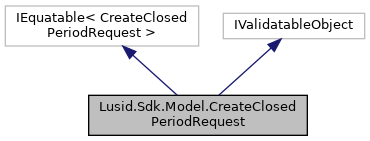
CreateClosedPeriodRequest
More...
|
| string | ClosedPeriodId [get, set] |
| | The unique Id of the Closed Period. The ClosedPeriodId, together with the Timeline Scope and Code, uniquely identifies a Closed Period More...
|
| |
| DateTimeOffset | EffectiveEnd [get, set] |
| | The effective end of the Closed Period More...
|
| |
| Dictionary< string, Property > | Properties [get, set] |
| | The Closed Periods properties. These will be from the 'ClosedPeriod' domain. More...
|
| |
| DateTimeOffset? | AsAtClosed [get, set] |
| | The asAt closed datetime for the Closed Period More...
|
| |
| string | DisplayName [get, set] |
| | The name of the Closed Period. More...
|
| |
| string | Description [get, set] |
| | A description for the Closed Period. More...
|
| |
| DateTimeOffset? | HoldingsAsAtClosedOverride [get, set] |
| | The optional AsAtClosed Override to use for building holdings in the Closed Period.If not specified, the AsAtClosed on the Closed Period will be used. More...
|
| |
| DateTimeOffset? | ValuationAsAtClosedOverride [get, set] |
| | The optional AsAtClosed Override to use for performing valuations in the Closed Period.If not specified, the AsAtClosed on the Closed Period will be used. More...
|
| |
◆ CreateClosedPeriodRequest() [1/2]
| Lusid.Sdk.Model.CreateClosedPeriodRequest.CreateClosedPeriodRequest |
( |
| ) |
|
|
inlineprotected |
◆ CreateClosedPeriodRequest() [2/2]
| Lusid.Sdk.Model.CreateClosedPeriodRequest.CreateClosedPeriodRequest |
( |
string |
closedPeriodId = default(string), |
|
|
DateTimeOffset |
effectiveEnd = default(DateTimeOffset), |
|
|
Dictionary< string, Property > |
properties = default(Dictionary<string, Property>), |
|
|
DateTimeOffset? |
asAtClosed = default(DateTimeOffset?), |
|
|
string |
displayName = default(string), |
|
|
string |
description = default(string), |
|
|
DateTimeOffset? |
holdingsAsAtClosedOverride = default(DateTimeOffset?), |
|
|
DateTimeOffset? |
valuationAsAtClosedOverride = default(DateTimeOffset?) |
|
) |
| |
|
inline |
Initializes a new instance of the CreateClosedPeriodRequest class.
- Parameters
-
| closedPeriodId | The unique Id of the Closed Period. The ClosedPeriodId, together with the Timeline Scope and Code, uniquely identifies a Closed Period (required). |
| effectiveEnd | The effective end of the Closed Period. |
| properties | The Closed Periods properties. These will be from the 'ClosedPeriod' domain.. |
| asAtClosed | The asAt closed datetime for the Closed Period. |
| displayName | The name of the Closed Period.. |
| description | A description for the Closed Period.. |
| holdingsAsAtClosedOverride | The optional AsAtClosed Override to use for building holdings in the Closed Period.If not specified, the AsAtClosed on the Closed Period will be used.. |
| valuationAsAtClosedOverride | The optional AsAtClosed Override to use for performing valuations in the Closed Period.If not specified, the AsAtClosed on the Closed Period will be used.. |
◆ Equals() [1/2]
◆ Equals() [2/2]
| override bool Lusid.Sdk.Model.CreateClosedPeriodRequest.Equals |
( |
object |
input | ) |
|
|
inline |
Returns true if objects are equal
- Parameters
-
| input | Object to be compared |
- Returns
- Boolean
◆ GetHashCode()
| override int Lusid.Sdk.Model.CreateClosedPeriodRequest.GetHashCode |
( |
| ) |
|
|
inline |
Gets the hash code
- Returns
- Hash code
◆ ToJson()
| virtual string Lusid.Sdk.Model.CreateClosedPeriodRequest.ToJson |
( |
| ) |
|
|
inlinevirtual |
Returns the JSON string presentation of the object
- Returns
- JSON string presentation of the object
◆ ToString()
| override string Lusid.Sdk.Model.CreateClosedPeriodRequest.ToString |
( |
| ) |
|
|
inline |
Returns the string presentation of the object
- Returns
- String presentation of the object
◆ AsAtClosed
| DateTimeOffset? Lusid.Sdk.Model.CreateClosedPeriodRequest.AsAtClosed |
|
getset |
The asAt closed datetime for the Closed Period
The asAt closed datetime for the Closed Period
◆ ClosedPeriodId
| string Lusid.Sdk.Model.CreateClosedPeriodRequest.ClosedPeriodId |
|
getset |
The unique Id of the Closed Period. The ClosedPeriodId, together with the Timeline Scope and Code, uniquely identifies a Closed Period
The unique Id of the Closed Period. The ClosedPeriodId, together with the Timeline Scope and Code, uniquely identifies a Closed Period
◆ Description
| string Lusid.Sdk.Model.CreateClosedPeriodRequest.Description |
|
getset |
A description for the Closed Period.
A description for the Closed Period.
◆ DisplayName
| string Lusid.Sdk.Model.CreateClosedPeriodRequest.DisplayName |
|
getset |
The name of the Closed Period.
The name of the Closed Period.
◆ EffectiveEnd
| DateTimeOffset Lusid.Sdk.Model.CreateClosedPeriodRequest.EffectiveEnd |
|
getset |
The effective end of the Closed Period
The effective end of the Closed Period
◆ HoldingsAsAtClosedOverride
| DateTimeOffset? Lusid.Sdk.Model.CreateClosedPeriodRequest.HoldingsAsAtClosedOverride |
|
getset |
The optional AsAtClosed Override to use for building holdings in the Closed Period.If not specified, the AsAtClosed on the Closed Period will be used.
The optional AsAtClosed Override to use for building holdings in the Closed Period.If not specified, the AsAtClosed on the Closed Period will be used.
◆ Properties
| Dictionary<string, Property> Lusid.Sdk.Model.CreateClosedPeriodRequest.Properties |
|
getset |
The Closed Periods properties. These will be from the 'ClosedPeriod' domain.
The Closed Periods properties. These will be from the 'ClosedPeriod' domain.
◆ ValuationAsAtClosedOverride
| DateTimeOffset? Lusid.Sdk.Model.CreateClosedPeriodRequest.ValuationAsAtClosedOverride |
|
getset |
The optional AsAtClosed Override to use for performing valuations in the Closed Period.If not specified, the AsAtClosed on the Closed Period will be used.
The optional AsAtClosed Override to use for performing valuations in the Closed Period.If not specified, the AsAtClosed on the Closed Period will be used.
The documentation for this class was generated from the following file:
- /home/docs/checkouts/readthedocs.org/user_builds/lusid-sdk-csharp/checkouts/latest/sdk/Lusid.Sdk/Model/CreateClosedPeriodRequest.cs