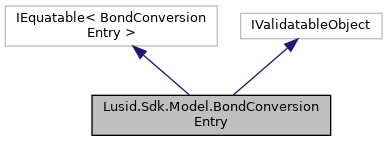
Information required to specify a conversion event for a convertible bond.
More...
|
| DateTimeOffset | Date [get, set] |
| | The date at which the bond can be converted More...
|
| |
| decimal | Denomination [get, set] |
| | The number of shares to be issued on conversion will be equal to the denomination of the bond divided by the conversion price. Two (and only two) entries out of (Price, Ratio, Denomination) must be provided. So, to allow one entry out of the three to not be provided, we make all the three nullable defaulting to zero and during validation we check if there is exactly one of the three equal to zero. More...
|
| |
| decimal | Price [get, set] |
| | The conversion price Two (and only two) entries out of (Price, Ratio, Denomination) must be provided. So, to allow one entry out of the three to not be provided, we make all the three nullable defaulting to zero and during validation we check if there is exactly one of the three equal to zero. More...
|
| |
| decimal | Ratio [get, set] |
| | The number of common shares received at the time of conversion for each convertible bond Two (and only two) entries out of (Price, Ratio, Denomination) must be provided. So, to allow one entry out of the three to not be provided, we make all the three nullable defaulting to zero and during validation we check if there is exactly one of the three equal to zero. More...
|
| |
Information required to specify a conversion event for a convertible bond.
◆ BondConversionEntry()
| Lusid.Sdk.Model.BondConversionEntry.BondConversionEntry |
( |
DateTimeOffset |
date = default(DateTimeOffset), |
|
|
decimal |
denomination = default(decimal), |
|
|
decimal |
price = default(decimal), |
|
|
decimal |
ratio = default(decimal) |
|
) |
| |
|
inline |
Initializes a new instance of the BondConversionEntry class.
- Parameters
-
| date | The date at which the bond can be converted. |
| denomination | The number of shares to be issued on conversion will be equal to the denomination of the bond divided by the conversion price. Two (and only two) entries out of (Price, Ratio, Denomination) must be provided. So, to allow one entry out of the three to not be provided, we make all the three nullable defaulting to zero and during validation we check if there is exactly one of the three equal to zero.. |
| price | The conversion price Two (and only two) entries out of (Price, Ratio, Denomination) must be provided. So, to allow one entry out of the three to not be provided, we make all the three nullable defaulting to zero and during validation we check if there is exactly one of the three equal to zero.. |
| ratio | The number of common shares received at the time of conversion for each convertible bond Two (and only two) entries out of (Price, Ratio, Denomination) must be provided. So, to allow one entry out of the three to not be provided, we make all the three nullable defaulting to zero and during validation we check if there is exactly one of the three equal to zero.. |
◆ Equals() [1/2]
◆ Equals() [2/2]
| override bool Lusid.Sdk.Model.BondConversionEntry.Equals |
( |
object |
input | ) |
|
|
inline |
Returns true if objects are equal
- Parameters
-
| input | Object to be compared |
- Returns
- Boolean
◆ GetHashCode()
| override int Lusid.Sdk.Model.BondConversionEntry.GetHashCode |
( |
| ) |
|
|
inline |
Gets the hash code
- Returns
- Hash code
◆ ToJson()
| virtual string Lusid.Sdk.Model.BondConversionEntry.ToJson |
( |
| ) |
|
|
inlinevirtual |
Returns the JSON string presentation of the object
- Returns
- JSON string presentation of the object
◆ ToString()
| override string Lusid.Sdk.Model.BondConversionEntry.ToString |
( |
| ) |
|
|
inline |
Returns the string presentation of the object
- Returns
- String presentation of the object
◆ Date
| DateTimeOffset Lusid.Sdk.Model.BondConversionEntry.Date |
|
getset |
The date at which the bond can be converted
The date at which the bond can be converted
◆ Denomination
| decimal Lusid.Sdk.Model.BondConversionEntry.Denomination |
|
getset |
The number of shares to be issued on conversion will be equal to the denomination of the bond divided by the conversion price. Two (and only two) entries out of (Price, Ratio, Denomination) must be provided. So, to allow one entry out of the three to not be provided, we make all the three nullable defaulting to zero and during validation we check if there is exactly one of the three equal to zero.
The number of shares to be issued on conversion will be equal to the denomination of the bond divided by the conversion price. Two (and only two) entries out of (Price, Ratio, Denomination) must be provided. So, to allow one entry out of the three to not be provided, we make all the three nullable defaulting to zero and during validation we check if there is exactly one of the three equal to zero.
◆ Price
| decimal Lusid.Sdk.Model.BondConversionEntry.Price |
|
getset |
The conversion price Two (and only two) entries out of (Price, Ratio, Denomination) must be provided. So, to allow one entry out of the three to not be provided, we make all the three nullable defaulting to zero and during validation we check if there is exactly one of the three equal to zero.
The conversion price Two (and only two) entries out of (Price, Ratio, Denomination) must be provided. So, to allow one entry out of the three to not be provided, we make all the three nullable defaulting to zero and during validation we check if there is exactly one of the three equal to zero.
◆ Ratio
| decimal Lusid.Sdk.Model.BondConversionEntry.Ratio |
|
getset |
The number of common shares received at the time of conversion for each convertible bond Two (and only two) entries out of (Price, Ratio, Denomination) must be provided. So, to allow one entry out of the three to not be provided, we make all the three nullable defaulting to zero and during validation we check if there is exactly one of the three equal to zero.
The number of common shares received at the time of conversion for each convertible bond Two (and only two) entries out of (Price, Ratio, Denomination) must be provided. So, to allow one entry out of the three to not be provided, we make all the three nullable defaulting to zero and during validation we check if there is exactly one of the three equal to zero.
The documentation for this class was generated from the following file:
- /home/docs/checkouts/readthedocs.org/user_builds/lusid-sdk-csharp/checkouts/latest/sdk/Lusid.Sdk/Model/BondConversionEntry.cs